
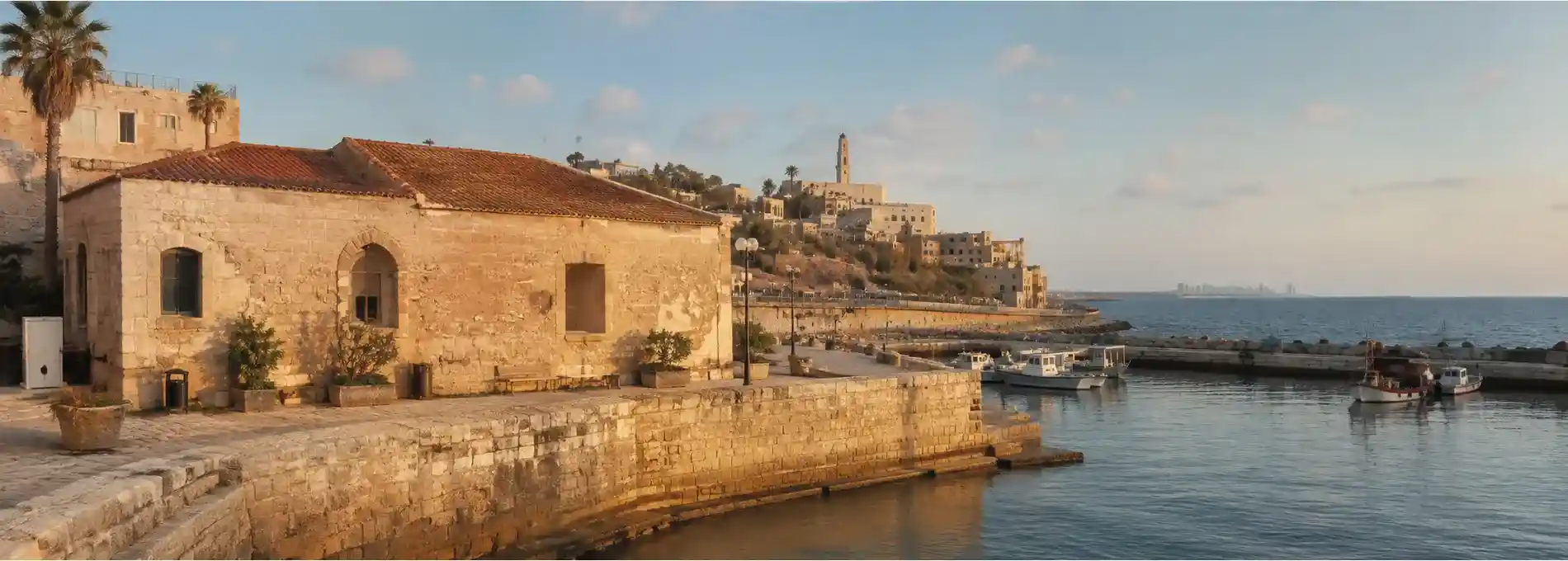
The Etzel Museum and the story of Israel’s independence belong in a wider itinerary about the transition from the British Mandate to the establishment of the State of Israel. One practical point matters at the beginning: the museum is not in Jerusalem itself. Its waterfront site is in Tel Aviv, close to Jaffa, which makes it a longer day trip or a useful extension for travelers moving between the two cities. Approached with that geography in mind, the museum offers a focused way to examine the Etzel, also known as the Irgun, and the organization’s role in the events surrounding 1948.
The Council for Conservation of Heritage Sites in Israel describes the museum as focusing on Etzel’s activities in the struggle for the establishment of a Jewish state, beginning with the United Nations partition resolution and continuing through the battle for Jaffa. That institutional focus gives the visit a clear shape, but it also means the museum represents a particular national narrative. Read it closely, then place it beside other sources and sites that describe the same period from different perspectives. Historical understanding becomes stronger when a museum’s purpose is visible rather than hidden.
Start with the place before the exhibition
The waterfront location changes the emotional register of the visit. Charles Clore Park and the sea create an open horizon, while the museum’s building and surviving historic fabric point toward the dense urban history of Jaffa and Tel Aviv. Before entering, look at the relationship between the structure, the shoreline, the park, and the newer city around it. The view helps explain why this is not simply an indoor collection. The building is part of the story.
Jaffa’s shoreline has been reshaped many times, and the museum sits within an area where older neighborhoods, modern planning, public parks, and national memory overlap. Do not treat the sea as a neutral backdrop. It connects the museum to the movement of people, goods, armies, and ideas along the coast. A short walk outside can help you see how a site about underground activity and military action now occupies a public leisure landscape.
Give yourself time to arrive without immediately searching for the most famous object. Read the exterior, notice what has been preserved, and ask which parts of the surrounding landscape are visible and which have disappeared. Museums often make history feel contained. The waterfront reminds you that the events described inside also changed streets, communities, buildings, and coastlines beyond the display cases.
Read the Etzel story as a sequence
Etzel was a Jewish underground organization active during the British Mandate period. The museum follows its operations and its role in the struggle that led to independence. A first-time visitor can follow the exhibition through a sequence of questions: what political conditions shaped the organization, how did underground activity operate, how were actions remembered, and how did the events of 1948 change the meaning of earlier decisions?
Photographs, documents, newspaper material, objects, and film can make a political history immediate. Resist the temptation to read every artifact as self-explanatory. Ask who created it, when it was created, and what audience it addressed. A photograph may document an event, but its caption and later use can also shape memory. A newspaper may reveal the language of the period while reflecting the interests of its publisher. The museum is most useful when it encourages this kind of active reading.
The battle for Jaffa is central to the museum’s story and to the building’s memorial purpose. The event should be approached as part of a wider 1948 history involving military operations, displacement, changing control of the city, and competing memories. A short museum visit cannot provide every perspective. It can give you a focused account and a set of questions to carry into Jaffa’s streets, archives, and other museums.
Menachem Begin’s later political career can also affect how visitors interpret the museum. Do not allow the later public figure to erase the earlier underground context, and do not let the museum’s commemorative language turn a complex period into a simple morality tale. The goal is not to flatten the story into neutral abstraction. It is to distinguish between commemoration, military history, political argument, and the human effects of conflict.
Hold the context beyond the museum
After the visit, compare the Etzel story with the Museum of the Underground Prisoners in Jerusalem, which focuses on the experience of Jewish underground prisoners during the Mandate period. The comparison can reveal how the same period looks different when the subject is an organization’s operations in Jaffa versus the cells, routines, and personal stories of imprisonment. Linking the two sites does not produce one final account. It makes the historical frame wider.
You can also use the waterfront setting to think about absence. Museums often preserve objects and names, while the city outside continues to be rebuilt. Which communities and buildings are visible in the exhibition? Which are present only through brief references? Which histories would require another museum, archive, or walking route? These questions are not an accusation against every exhibition. They are a practical method for reading any institution honestly.
If your base is Jerusalem, treat Etzel as a dedicated excursion rather than something to squeeze between Old City sites. The journey to Tel Aviv and Jaffa takes time, and the coastal heat can change the pace of the day. Pair it with a broader Jaffa walk or a return route that leaves room for food and rest. The museum is strongest when you can stay with its narrative without watching the clock.
Before you go
Check the museum’s current opening arrangements, reservations, language options, and accessibility information. Museum schedules and temporary exhibitions can change, and the site may use advance coordination for groups. Wear comfortable shoes if you plan to combine the visit with the promenade or Jaffa, and carry water in warm weather.
Photography rules may differ between public areas and exhibition spaces. Follow staff instructions, avoid photographing other visitors without permission, and do not treat memorial objects as props. If you are travelling with children, explain beforehand that the museum presents political and military history, including loss and conflict, so the visit can be paced appropriately.
For a Jerusalem-based history itinerary, connect this article with The Best Historical Museums to Visit in Jerusalem and the City of David archaeology guide. Together, the routes show how Israel’s story is encountered through national museums, archaeological sites, former prisons, underground organizations, and the everyday city around them.
The Etzel Museum is valuable not because it closes the story of independence, but because it gives one organized entry into it. Look closely, read the labels as part of the institution’s voice, and leave enough time to place the exhibition within Jaffa’s layered landscape. The visit then becomes more than a stop on the coast. It becomes a lesson in how nations preserve, frame, and argue with their own past.
References & Visitor Notes
The museum’s stated focus and heritage context are informed by the Council for Conservation of Heritage Sites in Israel guide to The Etzel Museum 1948. For a complementary Jerusalem perspective on the Mandate period, see the heritage guide to the Museum of the Underground Prisoners. Confirm current museum information before travelling.