
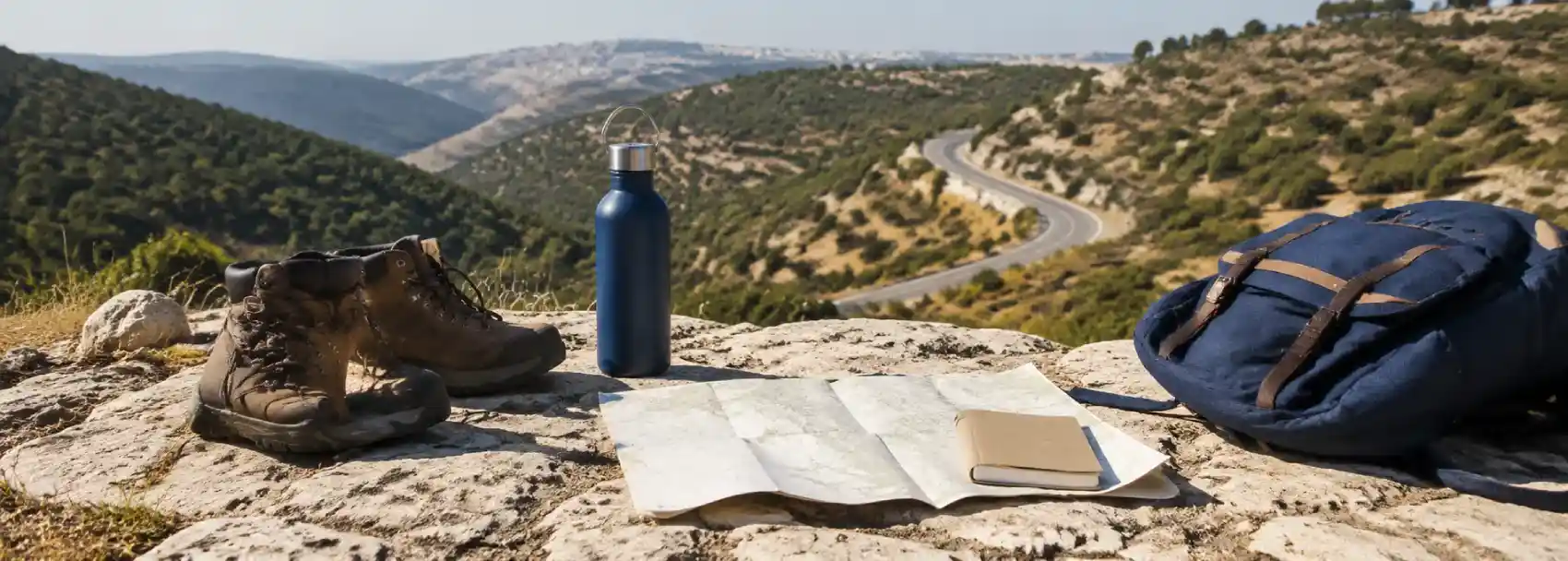
How to plan a half-day escape from Jerusalem is less a question of distance than of rhythm. The Judean Hills are close enough to invite an easy change of scene, but a short outing can still become tiring when it includes too many roads, trails, viewpoints, and hoped-for stops. The strongest half-day route chooses one central idea and lets the landscape do the rest. Follow water at Sataf, walk beneath the trees in Jerusalem Forest, or combine sculpture and viewpoints at Tzora Forest. Leave enough time for the place you came to see.
A half day can be the perfect scale for Jerusalem travel. It creates a pause between city visits without demanding a full day of logistics. It also keeps the experience focused. Instead of trying to summarize the entire western hillside, you can understand one spring system, one forest path, or one ridge. The aim is not to collect the maximum number of locations. It is to return to the city with a clearer sense of how Jerusalem sits within its surrounding terrain.
Start with the kind of experience you want
Begin by deciding what you want the outing to feel like. A water-and-terrace route suits travelers who want agricultural history, a short descent, and close contact with stonework and orchards. A forest route works better when the priority is shade, a steady walk, and a green break from the built city. An art-and-viewpoint route is ideal when the group prefers a flexible drive with the option to stop for short walks. These are not rigid categories. They are a way to keep the day from becoming a series of unrelated pins on a map.
Then set a return time before you leave. A half-day route should have a clear turning point. If the walk is going well, you can always return another day for the longer version. This simple decision protects the best part of the visit, because you are less likely to spend the final hour watching the clock, searching for a place to park, or rushing through a trail that deserved more attention.
Choose one of three landscape-led routes
For water and ancient agriculture, make Sataf the center of the outing. KKL-JNF describes the site around two springs, Ein Sataf and Ein Bikura, with collection pools, irrigation channels, orchards, and terraces built into the Jerusalem Mountains. Begin with the upper view so the structure of the hillside is visible. Then descend only as far as the group can comfortably manage, using the marked paths to connect the springs and cultivated plots. The route is strongest when you stop to read the system rather than treating the pools as a single destination.
Sataf works well for a half day because you can adjust the walking distance without losing the main story. A shorter visit can stay near the upper parking area and viewpoint. A longer version can follow sections of the Village Trail, Dryland Farming Trail, or the blue-marked Baal Trail. The official site lists several parking areas and facilities, but current conditions should be checked before departure. Water, firm shoes, and protection from the sun matter even when the route looks close to the city.
For a forest walk close to Jerusalem, choose the Cedar Trail in Jerusalem Forest. KKL-JNF describes the route as a circular walk of around four kilometers that takes approximately two to three hours, with blue trail markings. The route begins near the Ontario Recreation Area, reached from the Herzl Avenue and Yad Vashem approach, and passes through planted woodland, recreation areas, viewpoints, and older agricultural traces. It is a good choice when your group wants a defined walk rather than a sightseeing circuit.
The Jerusalem Forest route also shows why a nearby landscape can feel spacious. The forest is connected to the city by roads and neighborhoods, yet the trail moves through trees, slopes, and open views toward the surrounding hills. Plan to walk steadily and stop occasionally, not to hurry around the loop. KKL-JNF advises carrying water, walking shoes, a hat, and provisions for a light meal, and recommends avoiding the hottest part of a summer day. Those details are more important than trying to add a second major destination.
For art, driving, and broad views, choose Tzora Forest and the Sculpture Trail. KKL-JNF describes the route as roughly nine kilometers, with environmental sculptures, recreation areas, scenic lookouts, and footpaths along the forest road. The entire route is open to private vehicles according to the official guide, which makes it flexible for visitors who want to combine short stops with a few longer walks. Choose one lookout, one sculpture area, and one woodland pause instead of attempting every branch.
Tzora is especially useful for a mixed group because the visit can expand or contract. Someone who prefers a gentle outing can remain near the vehicle and recreation areas. Another traveler can take a side path toward Tel Tzora or a ridge viewpoint, provided there is enough time, water, and daylight. The official route information notes multiple access points and restrictions that vary by road and vehicle type, so check it before setting out.
Keep the rhythm realistic
A good half-day itinerary usually has three movements: arrival, immersion, and return. Arrival includes the drive, parking, and the first orientation pause. Immersion is the main walk or landscape reading, and it should occupy most of the available time. Return means leaving enough margin to retrace the road, find the next connection, or make a short unscheduled stop without turning the day into a race.
Build in a quiet pause near the middle of the route. At Sataf, that might be shade near the terraces or a view across the valley. In Jerusalem Forest, it might be a recreation area beneath the trees. At Tzora, it could be a lookout where the sculptures recede and the ridge becomes the subject. The pause is not wasted time. It is when the details collected along the route begin to form a coherent memory.
Be honest about the group’s walking pace. Distances on a route description do not include photographs, questions, uneven ground, water breaks, or the time needed to find the correct path. A family with young children, a mixed-ability group, and an experienced walker may need very different schedules. Choosing the shorter version of a route is not a lesser experience. It often leaves more room to notice what you came for.
Before you go
Check official information on the day of travel for access, road restrictions, opening arrangements, weather, and trail conditions. The KKL-JNF pages for Sataf, Jerusalem Forest, and Tzora Forest are useful starting points, while the Israel Nature and Parks Authority provides current information for nearby national parks such as En Hemed. Do not assume that an old itinerary, a map pin, or a previous visit describes today’s conditions.
Pack water, sun protection, comfortable shoes, and a light layer for changing conditions. Keep a charged phone, but do not rely on a signal or a last-minute route search as your only preparation. If you are driving, confirm parking and road access before leaving the city. If you are using public transportation or a taxi, allow extra time for the final approach and for the return journey.
Respect the landscape as a lived and maintained place. Stay on marked trails, avoid cultivated plots, take rubbish with you, and give space to local visitors and workers. In forests, follow fire guidance and never leave a flame unattended. At springs and heritage sites, do not damage stonework or treat old channels and pools as props.
The best half-day escape does not feel like an abbreviated full-day tour. It has its own shape: one landscape, one question, one satisfying walk, and a return to Jerusalem before the experience becomes rushed. Choose carefully, leave margin, and let the Judean Hills provide the change of pace.
References & Visitor Notes
Route and site details are based on the KKL-JNF Sataf site guide, the KKL-JNF Jerusalem Forest Cedar Trail guide, the KKL-JNF Sculpture Trail guide, and the Israel Nature and Parks Authority page for En Hemed National Park. Check each official source before visiting because access and conditions can change.