
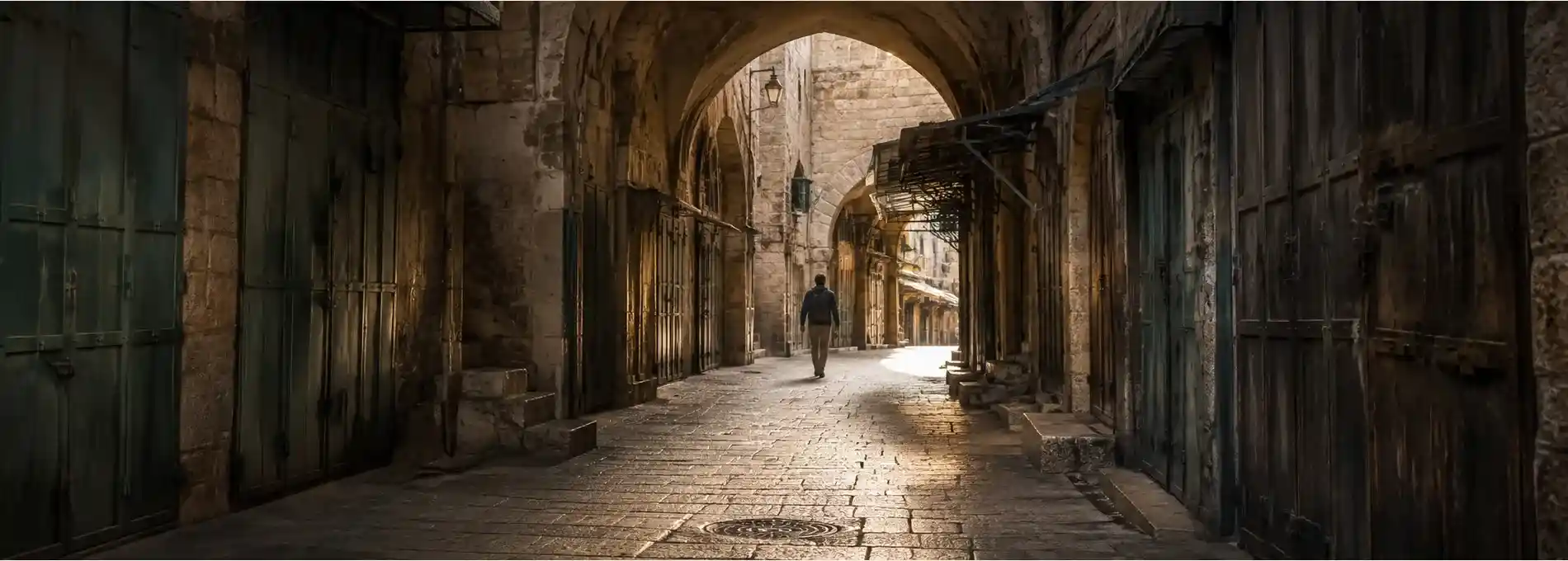
Jerusalem’s Old City rewards the traveler who allows the itinerary to breathe. A single walk can move from a gate in the Ottoman walls to a market lane, from a place of prayer to a quiet rooftop, with centuries of change compressed into a few minutes. The best first visit is not a race through a list of landmarks. It is a route with enough structure to keep you oriented and enough space to notice what happens between the famous places.
The Old City and its walls are a World Heritage property, and UNESCO describes Jerusalem as a city of exceptional symbolic importance to Judaism, Christianity, and Islam. Its heritage is not contained in one monument. It lives in the relationship between buildings, streets, rituals, businesses, archaeology, and the communities that continue to use the city every day. That is why a thoughtful walk should begin with the urban fabric rather than with a single photograph.
Choose an arrival that gives the walk a shape
Jaffa Gate is a natural starting point for a first route because it makes the transition into the Old City easy to understand. You arrive from the modern city, pass through the wall, and immediately encounter a sequence of courtyards, stone passages, and branching lanes. Current Jerusalem travel guidance notes that the Jaffa Gate approach can lead toward the Armenian, Christian, and Muslim quarters, while the New Gate offers a more direct approach to the Christian Quarter and Damascus Gate places you close to the Muslim Quarter and its market streets.
Do not treat the gate as a finish line. Pause outside it first. Look at the thickness of the wall, the change in pavement, and the way traffic gives way to pedestrians. That short pause helps establish the central rhythm of the city: the Old City is both a heritage destination and a working neighborhood. Residents, worshippers, shopkeepers, students, guides, and visitors all share the same narrow public spaces.
Shape the route around thresholds
From Jaffa Gate, follow the first shaded passage without trying to reach the deepest landmark immediately. The opening section of the walk is about thresholds. Stone arches frame glimpses of courtyards. Closed shutters reveal the rhythm of shops before the market becomes busy. The route narrows, widens, turns, and changes its acoustics. Those shifts are useful orientation points, especially when several lanes appear to lead in the same direction.
Give the Armenian Quarter a slower reading. Its lanes often feel more enclosed and residential than the busiest market corridors, and that contrast is part of the experience. The point is not to make a sweeping claim about an entire community from one short visit. Instead, notice how monasteries, residences, workshops, walls, and quiet entrances occupy the same compact geography. The quarter is a reminder that Jerusalem’s history is carried not only by grand public monuments but also by institutions and daily patterns that are easy to miss.
Continue toward the Jewish Quarter and the Western Wall area when the route and current access arrangements allow. Here the scale changes again. Open plazas, exposed archaeological remains, and broader views create a sense of release after the enclosed lanes. The Western Wall Heritage Foundation maintains the official visitor information for the Western Wall and its associated sites, so check that source before planning a prayer visit, tunnel tour, or timed entry. Treat the plaza as a place of worship first. Clothing, photography, behavior, and movement should follow the rules posted on site.
Read the four quarters as a map, not a boundary
Maps commonly describe the Old City through four quarters: Armenian, Christian, Jewish, and Muslim. The framework is useful because it gives a first-time visitor a way to organize a dense urban landscape. It is not a complete explanation of Jerusalem, and it should not turn living communities into themed zones. A lane may carry several histories at once. A religious site may sit beside an ordinary home. A market may serve local residents and travelers at the same time.
The Christian Quarter is best approached with patience rather than with a checklist. The Church of the Holy Sepulchre is a major destination, but the surrounding lanes also deserve attention. Follow the movement of pilgrims, notice the changing light beneath the vaulted passages, and allow time for the practical reality that sacred places can have changing access arrangements. If a doorway is closed or a route is redirected, the walk has not failed. Jerusalem’s heritage is experienced through negotiation with the present.
In the Muslim Quarter, the market becomes a stronger part of the route. The stone architecture is joined by sound, scent, shop displays, deliveries, and conversation. Keep to the side when the lane is busy, ask before photographing people or businesses, and remember that a market is not simply scenery. Damascus Gate can make a useful exit or arrival point, but the most rewarding route may not be the straightest one. Let the pattern of the streets guide you while keeping a mental reference to the wall.
For a final perspective, climb toward a permitted rooftop, a wall promenade, or an open viewpoint outside the Old City. From above, the apparent complexity begins to settle into a pattern of walls, domes, courtyards, roofs, and planted spaces. The elevated view is valuable because it reveals the Old City as a connected settlement rather than a collection of isolated attractions. It also makes the next visit easier: you can see how a gate, a quarter, and a route relate to one another.
Before you go
Check current access rules, opening hours, transportation information, and official travel advice on the day of your visit. Jerusalem travel guidance notes that parking and vehicle access are handled outside much of the Old City, while several public transport options serve approaches near the walls. Conditions can change, so use current local information instead of relying on an old itinerary. Comfortable shoes matter more than a tightly packed schedule. Expect uneven paving, steps, narrow lanes, and periods of shade followed by strong sun.
Plan the walk around the kind of attention you want to give it. An early start can make the first passages quieter. Midday offers stronger contrasts of light and shade but may feel busier. Religious calendars, prayer times, holidays, weather, and security conditions can all change the experience. Leave room to pause, drink water, step aside for local movement, and change direction when a site or street asks for it.
A first walk through Jerusalem’s ancient quarters should leave you with better questions, not the feeling that the city has been exhausted. Which wall stones belong to which period? How do residents use a lane after visitors leave? Where does a sacred route meet an ordinary one? Those questions turn a short visit into the beginning of a longer relationship with the city.
References & Visitor Notes
Historical framing follows the UNESCO World Heritage Centre entry for the Old City of Jerusalem and its Walls. Arrival and transportation details should be checked against iTravelJerusalem’s current Old City access guide. For the Western Wall, prayer areas, and tunnel visits, consult the Western Wall Heritage Foundation visitor information.