
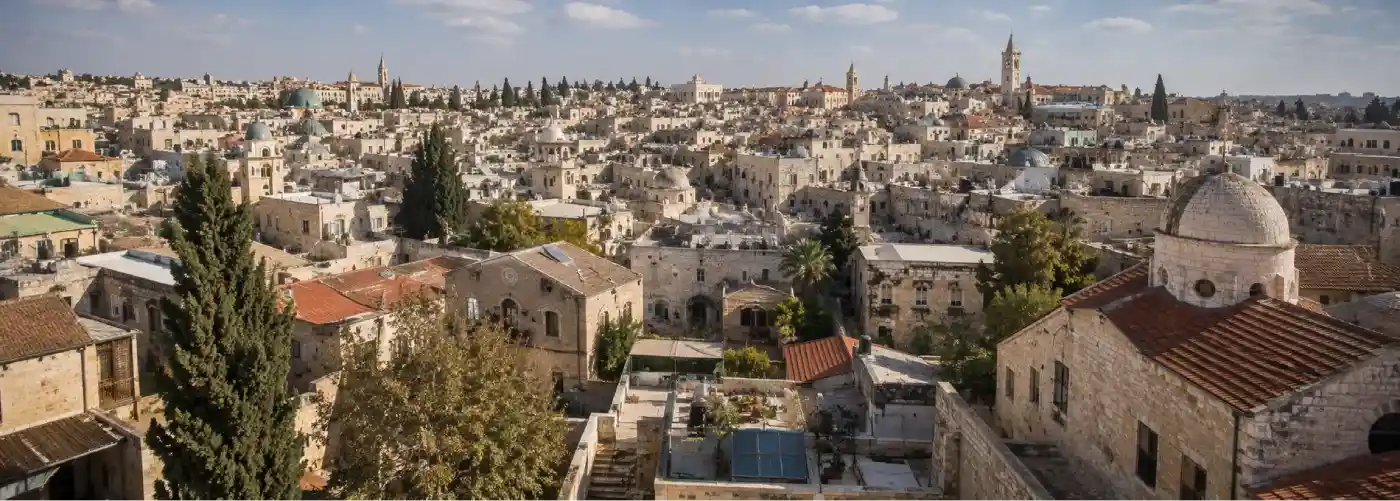
How to read Jerusalem’s four historic quarters begins with one important adjustment: the Old City is not a set of sealed historical displays. The names of the Jewish, Muslim, Christian, and Armenian quarters can help you orient yourself, but they do not explain everything you will see. Streets cross old boundaries, families live and work beside places of worship, and the same stone may carry religious, architectural, political, and personal meaning at once. The most rewarding visit uses the quarters as a starting map, then pays attention to the details that make each lane feel inhabited rather than preserved only for visitors.
Jerusalem is recognized by Judaism, Christianity, and Islam as a city of profound symbolic importance. UNESCO’s description of the Old City and its Walls emphasizes the concentration of historic monuments and the way sacred places sit within a compact urban landscape. That density changes the way a traveler should move. A short distance on a map can contain a shift in language, ritual, architecture, or access. Instead of trying to see everything, choose a few transitions and allow them to teach you how the city is organized.
A map, not a museum label
The four-quarter map is useful because it gives a first-time visitor a vocabulary. It helps you understand why a route from one gate to another can feel different even when the buildings share the same pale limestone. It can also help you locate major landmarks and decide whether your walk is primarily about markets, worship, archaeology, viewpoints, or everyday life. But a map is not the same as a complete account of the city. It simplifies a layered place, and its lines should be treated as orientation rather than as hard borders that explain every identity inside the walls.
Begin with the shape of the streets. Some lanes are broad enough for a steady flow of visitors, while others narrow into passages where a shopfront, doorway, or staircase controls the pace. Look at the height of the buildings and the way upper floors bridge the street. Notice when a route opens into a courtyard or a small square. These changes are often more revealing than a hurried list of landmarks because they show how the Old City works as a neighborhood. The quarters are not only historical categories. They are patterns of movement, work, worship, residence, and encounter.
Four ways to look
The Jewish Quarter is a place to think about memory, rebuilding, and the relationship between visible stone and the histories beneath it. A traveler may encounter synagogues, archaeological areas, residential streets, and routes leading toward the Western Wall. The Western Wall Heritage Foundation describes the wall as one of the supporting walls of the Temple Mount and as a place of prayer, heritage, and ceremony. That description is useful because it keeps the site from being reduced to a photograph. The plaza is not simply a viewpoint. It is an active religious space whose meaning is carried by the people who come to pray.
Walk through the Jewish Quarter slowly enough to notice the contrast between open viewpoints and compressed lanes. A rooftop or upper terrace may offer a broad view over the city, while a few steps later the route becomes intimate and residential. This alternation creates a lesson about Jerusalem’s scale. The city can feel monumental from above and intensely local at street level. Allow both impressions to remain true instead of choosing one as the official version.
The Muslim Quarter is often experienced first through movement. Markets, workshops, food stalls, doorways, and routes toward major sacred sites create a lively urban rhythm. The quarter is not a corridor built for sightseeing. It is a neighborhood where commerce and daily routines continue around visitors. When the lane is busy, move with the flow and avoid stopping in the middle of a passage. When a shopkeeper or resident is working, remember that the scene is part of someone’s day rather than a performance arranged for a camera.
The Christian Quarter is shaped by pilgrimage, devotion, and the presence of churches, chapels, religious communities, and businesses that serve travelers. The Church of the Holy Sepulchre is one of the Old City’s most significant Christian sites, but it should not be approached as a single image to collect. Its spaces are shared, layered, and often crowded. Give yourself time to understand the sequence of entrances, chapels, light, stone, and people waiting to pray. A quiet corner may be as meaningful to a worshipper as the most famous feature in a guidebook.
The Armenian Quarter has a more enclosed feeling in parts of its streets, with a strong sense of community, religious presence, and institutional life. Its quieter rhythm can make it tempting to assume that little is happening, yet quiet does not mean empty. Walk with particular care around gates, walls, and entrances that may serve residents or religious communities. The quarter offers an important reminder that the Old City is not only defined by its busiest routes. Some of its character is protected by a slower pace and by spaces that are not arranged for public display.
These descriptions are not boxes to place people inside. They are prompts for looking. The same traveler can move from a market to a prayer area, from an archaeological remnant to a family business, and from a wide view to a narrow stairway within minutes. The value of the four-quarter framework is that it encourages comparison while leaving room for the city’s overlaps and exceptions.
Turn context into a walk
A useful first route can begin at Jaffa Gate, continue toward the Christian Quarter, move east through busier market lanes, and then turn toward the Western Wall area before returning by a different street. This is not a fixed itinerary and should not be treated as a promise that every route will be open. It is a way to organize attention. You begin with a broad entrance, encounter pilgrimage and commerce, reach a major prayer space, and then notice how the city changes as you retrace part of the distance. For a more route-focused version of the same area, continue with A First Walk Through Jerusalem’s Ancient Quarters.
Choose one question for each section. In the Christian Quarter, ask how pilgrimage shapes movement. In the Muslim Quarter, look at the relationship between trade and passage. In the Jewish Quarter, consider how archaeology, rebuilding, and living religious practice occupy the same area. In the Armenian Quarter, notice how enclosure and quiet shape your sense of the neighborhood. These questions keep the route active. They prevent the visit from becoming a sequence of names disconnected from what your eyes and body are actually experiencing.
Do not measure the success of the walk by the number of sites entered. Jerusalem can be generous even when a doorway is closed or a line is too long. The stonework around a threshold, the sound of a service from behind a door, the arrangement of goods in a small shop, or the changing light on a wall can all become part of the route. Historical context is most useful when it makes you more attentive to the present rather than less interested in it.
Before you go
Check current access information for any religious site you plan to enter. Opening times, security arrangements, ceremonies, restoration work, and holiday schedules can affect the route. The Western Wall Heritage Foundation publishes visitor information for the Western Wall area, while the current guidance for other sites may come from the institution responsible for that site. Use official sources close to the date of travel and allow time for queues or a change of plan.
Dress with the spaces in mind. A route through the Old City can include streets, markets, prayer areas, and churches within the same morning. Clothing that covers the shoulders and knees is a practical choice for entering or approaching religious places, but specific requirements can vary. Carry a light layer or scarf so that you can adapt without turning the visit into a repeated shopping stop. Comfortable shoes matter because the route includes stone surfaces, steps, slopes, and long periods of standing.
Ask before photographing people, shop interiors, or religious activity. Do not touch sacred objects, interrupt a service, or enter a restricted area because a doorway appears open. Keep your voice low when a route passes through a prayer space, and follow signs or instructions from staff and local communities. Respect is not an extra feature added after the itinerary. It is the method that allows the itinerary to continue.
The four quarters are most helpful when they make you curious about the connections between places. Use the map to begin, then let the city complicate it. Walk from one threshold to the next, notice who is using the street, and give sacred spaces the attention they deserve. Jerusalem’s Old City becomes more legible when you stop searching for one final interpretation and start reading the layers that remain visible together.
References & Visitor Notes
The historical and religious framing in this guide follows the UNESCO World Heritage Centre entry for the Old City of Jerusalem and its Walls. The explanation of the Western Wall’s religious and heritage significance follows the Western Wall Heritage Foundation visitor information. Check the responsible institution’s current guidance before entering any site.