
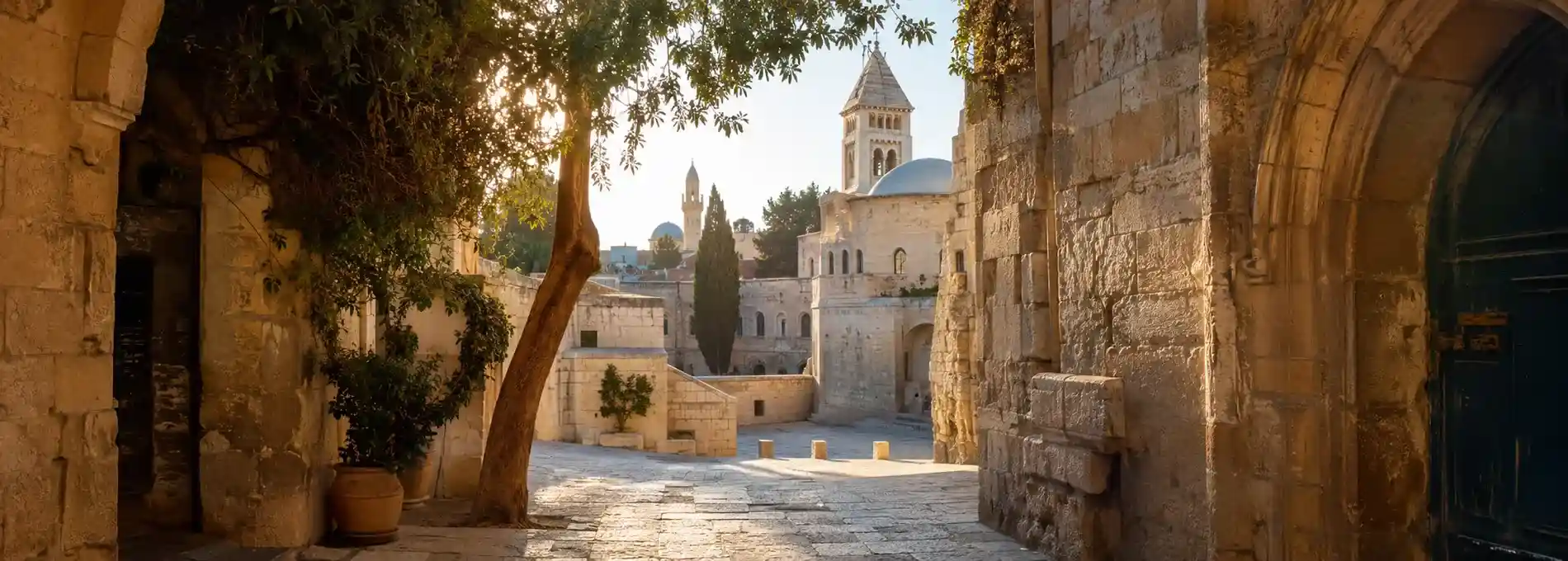
Sacred sites in Jerusalem are not simply attractions placed along a sightseeing route. They are places of prayer, memory, study, pilgrimage, community, and sometimes intense disagreement about history and belonging. Judaism, Christianity, and Islam all understand Jerusalem as a city of profound spiritual importance, while individual communities and traditions attach distinct meanings to particular spaces. A good visit begins by accepting that the traveler is entering places that matter to people before they matter to tourism.
UNESCO describes the Old City of Jerusalem and its Walls as a site of exceptional significance, with monuments and religious places connected to the three monotheistic traditions. The compact geography can make the city feel easy to cover in a morning, but physical closeness should not be mistaken for shared practice. A plaza, church, mosque, synagogue, cemetery, or shrine may operate according to its own calendar, dress expectations, security procedures, and rules about photography. The most useful itinerary is flexible enough to respond to those differences.
Begin with an approach, not a checklist
Before choosing specific sites, decide what kind of visit you want. A first-time traveler might focus on orientation and a few major landmarks. A pilgrim may need time for prayer and ritual. A student of architecture may want to compare entrances, courtyards, and building materials. A family may need short stops and quiet breaks. These are all legitimate ways to encounter Jerusalem, but they produce different routes. Naming your purpose prevents the day from becoming a race between places that deserve attention.
Use a map to understand distance, then use the street to understand atmosphere. Inside the Old City, short routes can include steps, uneven paving, crowds, and sudden changes in movement. A place that appears next door may require a slow detour or a wait at a controlled entrance. Build in pauses before and after a sacred site. Those pauses are not wasted time. They allow you to lower your voice, put away the camera, and make the transition from public street to devotional space.
It is also important to distinguish between historical evidence and religious tradition. A site can be historically documented, spiritually meaningful, architecturally significant, and contested in its interpretation at the same time. You do not need to resolve every question during a visit. You do need to avoid presenting one tradition’s devotional claim as if it were the only possible historical description, especially when speaking to other travelers or writing about the place afterward.
Read the city through three living traditions
Jewish heritage in Jerusalem can be approached through the Western Wall, the Jewish Quarter, the City of David, the southern excavations, cemeteries, synagogues, schools, and the many forms of study and prayer that shape the city. The Western Wall Heritage Foundation explains the wall as one of the supporting walls of the Temple Mount and as a place of prayer, heritage, and ceremony. For visitors, the key lesson is that the plaza is an active religious space. People may be praying, celebrating, studying, or mourning. Leave room for those activities rather than treating the plaza as a photo stop.
Christian heritage is visible through the Church of the Holy Sepulchre, the Via Dolorosa, the Christian Quarter, Mount Zion, the Mount of Olives, Gethsemane, and the many churches and religious communities that sustain pilgrimage routes. The same church may contain several chapels and devotional traditions, each with its own visual language and rhythm. Move slowly, watch for signs, and allow a service or procession to take priority. A visitor who arrives with a little historical context will see more than a famous façade. They will notice how pilgrimage is organized through thresholds, ritual, light, and repetition.
Muslim heritage can be approached through the Muslim Quarter, the Haram al-Sharif or Temple Mount complex, historic schools and charitable buildings, mosques, markets, and the wider urban culture of the Old City. Access to particular areas can be subject to changing rules, security arrangements, religious calendars, and separate entry procedures. Do not assume that an open market route guarantees access to a sacred complex. Confirm current conditions, follow local instructions, and understand that visitors may not be permitted to enter every space.
These traditions are not isolated compartments. The same street can connect a market, a church, a prayer plaza, a residential lane, and an archaeological site. Jerusalem’s heritage is layered in both the physical and social sense. That is why a respectful guide should name distinct traditions without pretending that the city can be divided into three perfectly separate experiences.
Shape a route with time and restraint
For a first visit, choose two or three anchor sites rather than attempting every famous location. One possible route begins at Jaffa Gate, continues through the Christian Quarter toward the Church of the Holy Sepulchre, follows market streets toward the Jewish Quarter and Western Wall area, and ends with a viewpoint or a quiet café outside the walls. Another route can focus on the Mount of Olives and then descend toward the Old City. The right choice depends on your interests, the day’s access conditions, and how much walking your group can comfortably manage.
Use A First Walk Through Jerusalem’s Ancient Quarters as a practical companion for the streets inside the walls, and compare it with the City of David and Jerusalem Walls archaeology guide if you want to connect sacred history with the city’s older infrastructure. The purpose of linking these routes is not to create one exhaustive day. It is to show how religious heritage, archaeology, and daily life overlap across a small geography.
Keep one open block in the itinerary. Lines may be longer than expected, a ceremony may temporarily change access, or a site may be more absorbing than the schedule allowed. Jerusalem rewards the traveler who can stay for ten more minutes when a courtyard becomes quiet, or who can turn away from a crowded entrance and notice the street outside. Flexibility is a form of respect because it prevents the traveler’s timetable from becoming the most important thing in the room.
Before you go
Check each site’s current visitor information close to the date of your visit. Rules can change for holidays, prayer times, security events, restoration, or official ceremonies. The Western Wall Foundation publishes information for its area, but other sites are responsible for their own schedules and procedures. If a religious site requires modest dress, plan for it before leaving your accommodation. Covering shoulders and knees is a practical baseline, but specific expectations can vary.
Carry water, wear shoes with a secure sole, and be prepared for stairs, slopes, and long periods of standing. Keep bags manageable because security checks can take time. Photography should never interrupt prayer or movement. Ask before photographing people, avoid flash where it is prohibited, and do not photograph restricted areas simply because a barrier is not obvious.
Children and first-time visitors benefit from a simple explanation before entering a sacred space: people may be silent, seated, singing, bowing, touching a wall, or moving through a ritual sequence. None of those actions are performances for visitors. A little preparation helps a group observe without staring and move without creating a disturbance.
Jerusalem’s sacred sites are most meaningful when the traveler allows the city to remain plural. Listen for the different languages of prayer, notice how buildings share the same limestone but not the same ritual, and remember that the route passes through neighborhoods where people live and work. The goal is not to collect proof of having been everywhere. It is to leave with a more careful understanding of why these places continue to matter.
References & Visitor Notes
The wider heritage framing follows the UNESCO World Heritage Centre entry for the Old City of Jerusalem and its Walls and UNESCO’s overview of Jerusalem’s significance to the three monotheistic religions. Visitor guidance for the Western Wall area follows the Western Wall Heritage Foundation visitor information. General dress and planning advice is informed by iTravelJerusalem’s Jerusalem attractions guide. Check each site’s current instructions before visiting.