
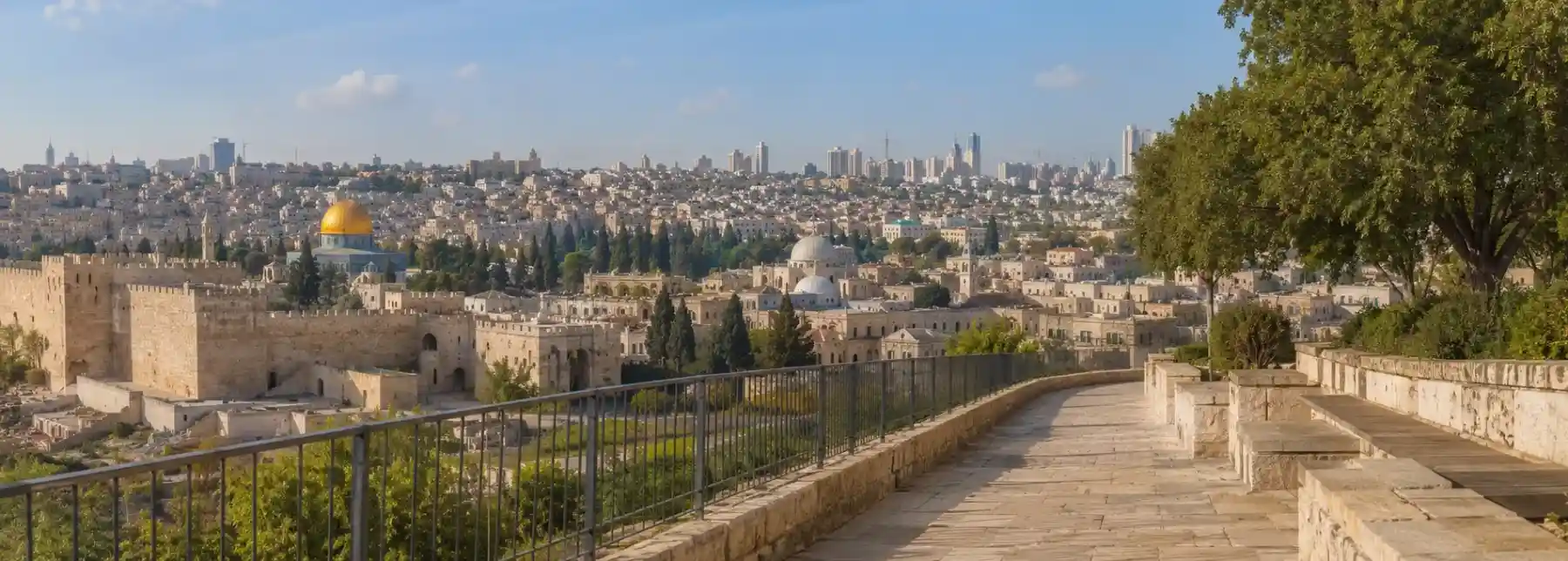
Two days in Jerusalem for first-time visitors should feel full without becoming a test of endurance. The city offers more famous sites than any short itinerary can hold, and the temptation is to move quickly from one name to the next. A better approach is to give the Old City one substantial block of time, then use the second day to choose a different layer: archaeology, museums, modern neighborhoods, or the hills beyond the center. That contrast gives a first visit shape and keeps the city from being reduced to a single postcard.
This itinerary is a framework rather than a timetable. Entry times, security arrangements, prayer schedules, weather, transport, and the interests of your group will change the order. Use the plan to group places geographically and thematically, then check each institution’s current information before you travel. The most successful two-day visit has one or two anchor reservations and enough open space to adjust.
Shape the two days around contrast
Jerusalem can be physically compact and emotionally dense. A morning inside the Old City may involve markets, sacred sites, steep lanes, and long pauses. A museum afternoon may require concentration rather than more walking. A day in the hills may feel open and quiet but still demand shoes, water, and transport planning. Put unlike experiences next to each other so that each one sharpens the other.
Use the first day for orientation and the second for interpretation. On day one, learn the Old City’s gates, quarters, streets, and sacred geography. On day two, take one of those questions further through archaeology, a museum, a central neighborhood, or a nearby landscape. This keeps the itinerary connected without forcing every destination into the same day.
Day one: Give the Old City time
Begin at a clear entrance, such as Jaffa Gate, and let the first hour be about orientation rather than accumulation. Look at the walls, the gate, the way visitors and residents move through the entrance, and the direction of the streets beyond. From there, make a deliberate route through the Christian Quarter, the market lanes, the Jewish Quarter, or another area that matches your priorities. A First Walk Through Jerusalem’s Ancient Quarters is a useful companion for thinking about the route as a sequence of thresholds.
Choose two or three anchor places inside the walls. You might focus on the Church of the Holy Sepulchre and the Christian Quarter, then continue toward the Western Wall area. You might prefer a broader route through the four historic quarters, with time for markets and viewpoints. If sacred sites are central to your visit, read the guide to Jewish, Christian, and Muslim heritage before you go so that dress, access, prayer, and photography expectations are part of the plan.
Leave a buffer for the places you did not expect to notice. A courtyard, a small workshop, a changing view over the roofs, or a quiet section of wall may hold the memory of the day better than another famous entrance. Eat and rest before the route becomes tiring. If your group needs to shorten the plan, end with a strong final stop rather than pushing through a long list.
For travelers who want to extend the Old City’s archaeological story, the City of David and Jerusalem Walls can be a focused alternative or an additional half-day, but do not treat it as a quick add-on if you plan to enter a water tunnel or take a guided tour. The topography and access arrangements deserve their own time.
Day two: Choose a layer to follow
Option one: Museum day. Choose the Tower of David Museum if you want a broad history of the city and you are staying near Jaffa Gate. Choose the Israel Museum or the Bible Lands Museum if archaeology and the ancient Near East are more important. Choose Yad Vashem for a dedicated day of Holocaust remembrance and reserve ahead according to the institution’s current guidance. The historical museums guide can help you match the museum to your interests and emotional bandwidth.
Option two: Archaeology and southern walls. Spend the morning at the City of David, the Gihon Spring story, the excavated areas, or the southern edge of the Old City, depending on current access and tickets. Then return to a neighborhood or museum with a different pace. This option is especially good for travelers who want to understand how water, walls, valleys, and religious history connect. Follow the City of David and Jerusalem Walls guide for a context-first visit.
Option three: Modern Jerusalem on foot. Walk through central streets that show the city beyond the postcard. A route along Strauss Street can reveal changing neighborhoods, older buildings, religious life, and everyday movement. The former No Man’s Land story can add a political and urban-history layer. These routes are less about checking off monuments and more about seeing how modern Jerusalem carries its past through street names, buildings, boundaries, and daily routines.
Option four: A landscape escape. If the weather is suitable and transport is practical, spend part of day two in the Judean Hills. Sataf offers springs, agricultural terraces, orchards, and marked paths, while a shorter hill route can provide a change of scale without requiring a full expedition. Read the Judean Hills collection and check current trail, parking, and site information before leaving the city. This option works best when the landscape is the main point of the day rather than an afterthought.
Before you go
Reserve any museum, tunnel, guided tour, or timed entry that matters to your plan. Then build the rest around it. Keep one flexible block each day because queues, security checks, ceremonies, traffic, and weather can change the order. Avoid promising a precise number of sites to children or tired travelers.
Wear comfortable shoes and carry water. Jerusalem’s stone surfaces, hills, steps, and long standing periods are part of every option. Clothing that covers the shoulders and knees gives you flexibility for religious sites, while a light layer helps with changing temperatures. Check individual requirements because expectations differ.
Use transport to protect the walking experience. A taxi or bus can save energy before a long Old City route or connect you to a museum campus. Check current routes and allow extra time for security and traffic. If you are driving, confirm parking and do not assume that the closest map point is the easiest pedestrian entrance.
Most importantly, do not measure the two days by how many locations you photograph. Measure them by whether you can explain how the Old City, the modern streets, the archaeological remains, and the surrounding hills relate to one another. A first visit becomes memorable when the route gives the city time to become more complicated.
References & Visitor Notes
This itinerary is informed by iTravelJerusalem’s current itinerary ideas and its half-day Old City itinerary. Site-specific planning should be checked against current official visitor information for each museum, religious site, archaeological park, and trail.